Homeowner education
How Central Air Conditioning Works
An air conditioner does not create cold air. It moves heat from inside your home to the outdoors, and removes moisture along the way.
Once that idea clicks, most cooling problems make sense: something is blocking heat from being collected, moved or released.
24/7 availability for urgent cooling problems in Gainesville and nearby areas.
The refrigerant cycle in four steps
- 1
Evaporate
Indoors, cold low-pressure refrigerant absorbs heat from house air passing over the evaporator coil. Moisture condenses on the cold fins and drains away.
- 2
Compress
The compressor in the outdoor unit raises the refrigerant's pressure and temperature so it is hotter than the outdoor air.
- 3
Condense
In the outdoor coil, that heat transfers to outdoor air blown across the fins, and the refrigerant returns to liquid.
- 4
Meter
A metering device drops the pressure again, and the cycle repeats as long as the thermostat calls for cooling.
The parts you can point at
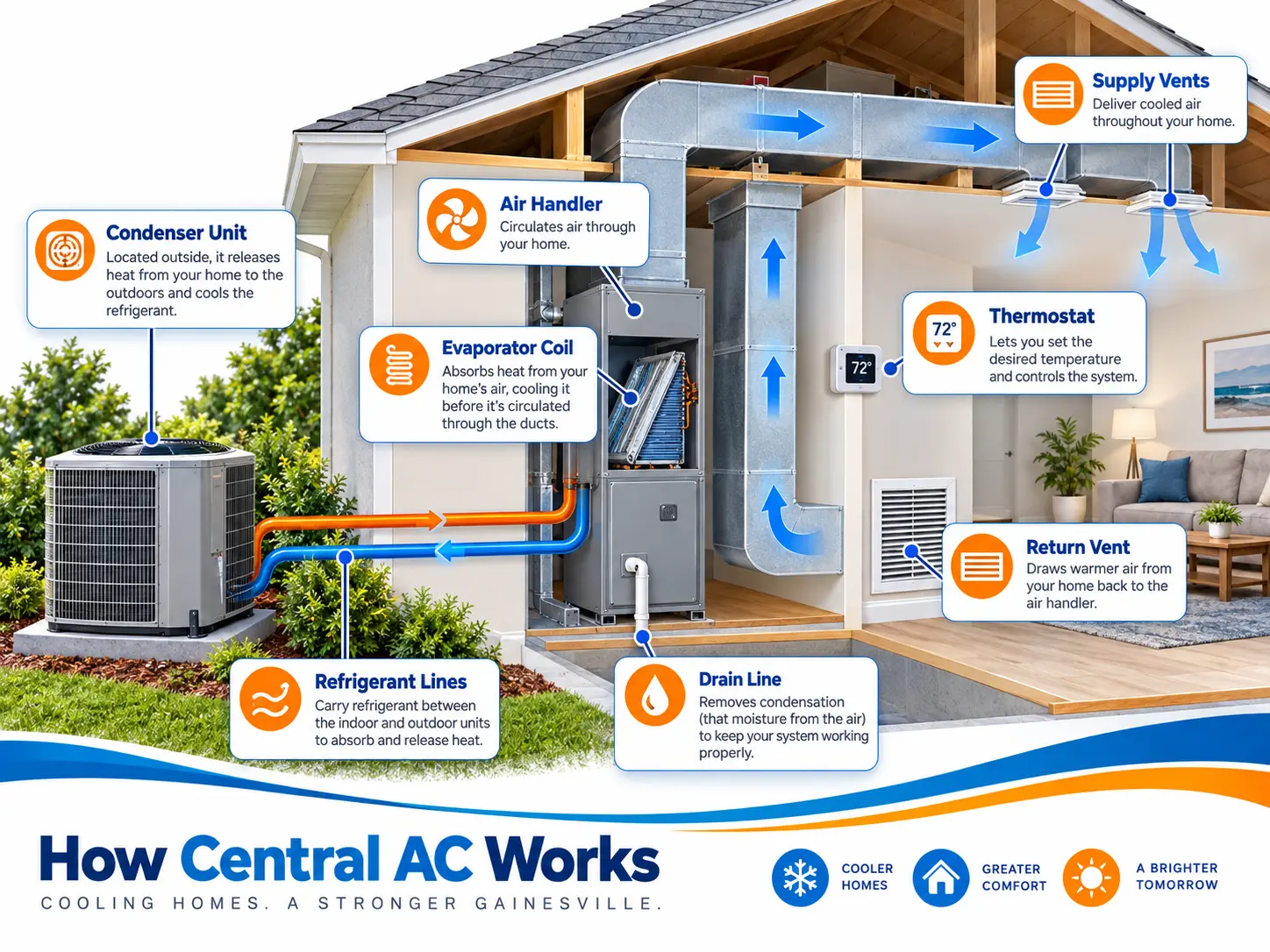
Condenser unit
Air handler
Evaporator coil
Refrigerant lines
Drain line
Thermostat and vents
Why humidity removal matters as much as temperature
In a humid climate, an air conditioner does a substantial part of its work removing moisture rather than lowering temperature. That is why a house at 76 degrees can feel comfortable or clammy depending on how the system runs.
Long, steady cooling cycles remove more moisture than short bursts. Oversized equipment satisfies the thermostat quickly and leaves humidity behind — one reason bigger is not better here.
What this means when something goes wrong
| Symptom | Which part of the cycle is affected |
|---|---|
| Warm air at the vents | Heat is not being moved — outdoor unit or compressor not operating |
| Weak cooling | Heat collection or release is impaired — airflow, dirty coils or low charge |
| Ice on the coil or lines | Coil temperature too low — restricted airflow or low refrigerant |
| Water indoors | Condensate cannot drain — clogged line, failed pump or damaged pan |
| High humidity | Too little run time or too much airflow across the coil |
| Short cycling | Controls, charge or oversized capacity interrupting the cycle early |
Heat pumps: the same cycle, reversed
Many Gainesville homes use heat pumps, which run the same refrigerant cycle and reverse it in winter to bring heat indoors. In cooling mode, a heat pump and a conventional air conditioner behave nearly identically.
The practical difference is winter operation and the reversing valve, plus a thermostat that must be configured for heat pump staging.
Frequently Asked Questions
- Does an air conditioner bring in outside air?
- A standard central system recirculates indoor air. Fresh air comes from ventilation openings, exhaust fans and normal building leakage, not from the AC itself.
- Why does my AC drip water outside?
- That is condensate the system pulled from your indoor air, leaving through the drain line. Steady dripping during operation is normal and healthy.
- Is refrigerant used up over time?
- No. It circulates in a sealed loop. If the charge is low, there is a leak that needs to be found and repaired.
- What does the outdoor fan actually do?
- It pulls outdoor air across the condenser coil to carry away the heat collected from your house. If it stops, pressures climb and cooling fails quickly.
Related pages
Prefer to talk it through? Call 352-707-8045 or send a service request.
AC Trouble in Gainesville?
Describe the symptoms and get help scheduling air conditioner repair. Service requests are available 24/7.