Residential AC repair
AC Repair in Gainesville, FL
Cooling problems in Alachua County rarely arrive at a convenient hour. Whether the system quit overnight or has been slipping for weeks, the fastest path to a fix starts with a clear description of what the air conditioner is doing.
Use this page to understand what is likely happening inside your system, what a technician checks, and what you can safely verify before requesting repair.
24/7 availability for urgent cooling problems in Gainesville and nearby areas.
What AC repair covers
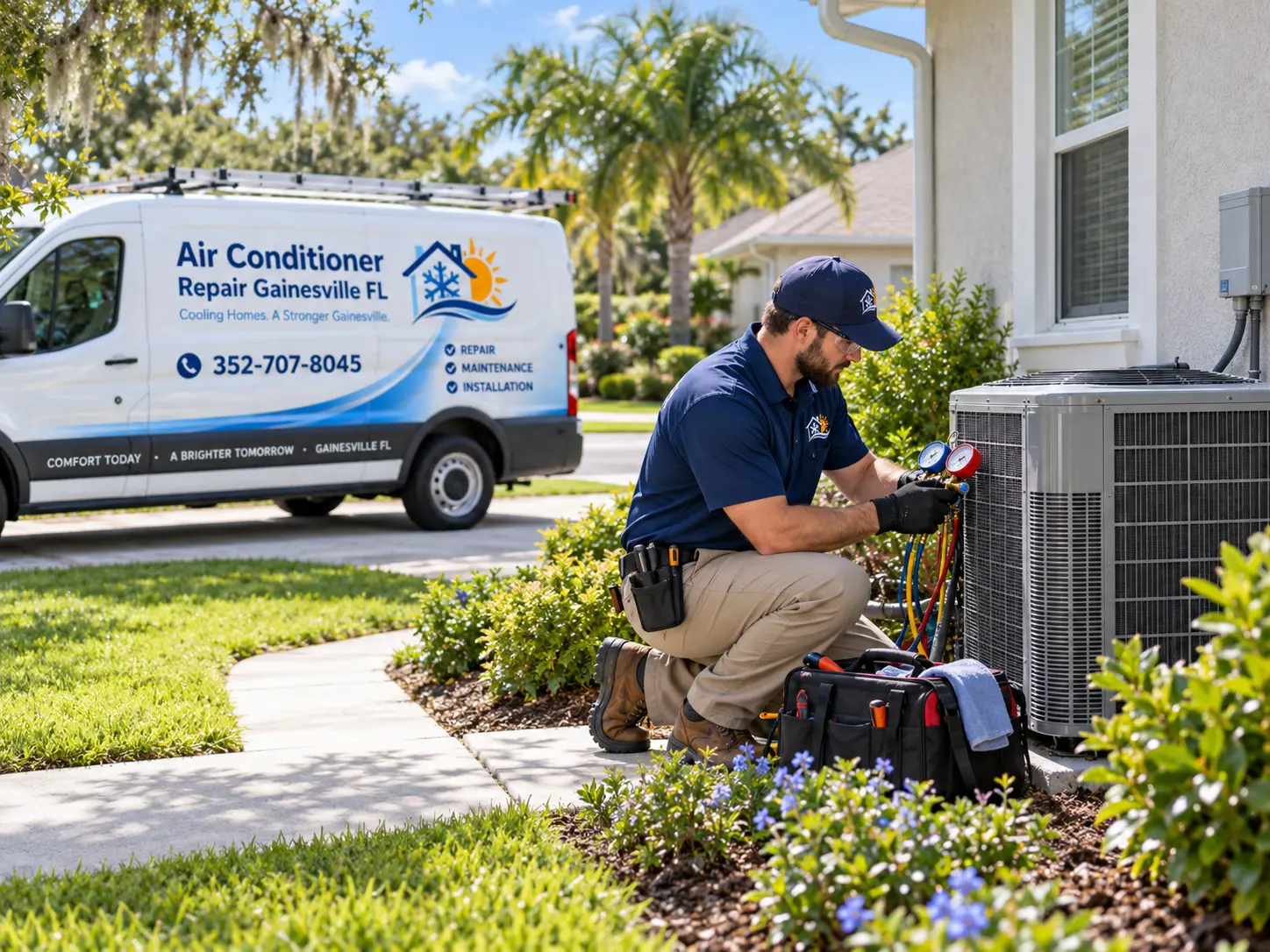
Most residential repairs fall into a handful of categories: electrical faults, refrigerant circuit problems, airflow restrictions, drainage failures and controls. A diagnosis identifies which system is failing before any parts are replaced.
Electrical and controls
Refrigerant circuit
Airflow
Condensate drainage
Outdoor unit
Thermostat and zoning
Symptoms that point to a repair
- The air from the vents is warm, room temperature or only slightly cool.
- The indoor unit runs constantly and the house never reaches the setpoint.
- The system starts and stops every few minutes.
- Water appears near the air handler or in an overflow pan.
- Ice forms on the indoor coil or the copper lines.
- The outdoor unit hums but the fan does not spin.
- Indoor humidity stays high even while the AC runs.
- The breaker or fuse for the air conditioner keeps tripping.
How a professional evaluates the system
- 1
Confirm the complaint
Verify the symptom with the system running: supply and return temperatures, airflow at the vents, and whether both indoor and outdoor units energize.
- 2
Check controls and safeties
Test thermostat operation, low-voltage power, float switches and door switches so an obvious safety trip is not mistaken for a mechanical failure.
- 3
Measure electrical values
Read capacitor microfarads, amp draw and voltage at the contactor to catch a weak component before it strands the system.
- 4
Inspect airflow
Check filter loading, blower wheel condition, static pressure and coil cleanliness — the most common cause of poor cooling and coil freezing.
- 5
Read the refrigerant circuit
Take pressures and temperatures, calculate subcooling and superheat, and look for oil residue that indicates a leak.
- 6
Explain findings and options
Review what failed, what it affects, and what the repair involves so you can authorize work with the full picture.
Safe checks before you request service
- Confirm the thermostat is set to COOL and the fan is set to AUTO or ON.
- Lower the setpoint a few degrees and listen for the system to start.
- Check that the thermostat has power — a blank screen often means dead batteries or a tripped safety switch.
- Look at the accessible air filter and replace it if it is visibly loaded with dust.
- Verify the indoor unit's service switch (it looks like a light switch near the air handler) was not flipped off.
- Walk the house and open blocked supply and return vents.
- Step outside and note whether the condenser fan is spinning.
- Look for standing water, drips or stains near the indoor unit.
Never open energized electrical panels, discharge capacitors, bypass a safety switch, add refrigerant or take apart a compressor. Those steps are dangerous and can turn a small repair into a large one.
When to stop troubleshooting and call
- You smell burning, hot plastic or an electrical odor.
- You see sparking, scorch marks or melted wiring.
- The breaker for the air conditioner trips again after one reset.
- Water is spreading into drywall, flooring or a ceiling.
- Ice is visible on the refrigerant lines or coil.
- The system makes a loud grinding, screeching or banging noise.
Air conditioner repair for Gainesville homes
Gainesville homes run cooling equipment for a long stretch of the year, and long run times expose weak parts. Filters load faster, blower wheels collect dust, condensate traps grow biological slime, and outdoor coils pack with pollen and grass clippings.
Gainesville includes homes of many ages and HVAC configurations, from older central neighborhoods to newer development west of the city. Equipment location, duct design and access can vary significantly from home to home.
Frequently Asked Questions
- How soon can someone look at my air conditioner?
- Service requests are accepted 24 hours a day. Scheduling depends on the nature of the problem and current demand, and urgent no-cooling calls during hot weather are prioritized. Calling 352-707-8045 is the fastest way to describe the situation.
- Do I need a diagnosis if I already know the part that failed?
- Usually yes. A failed capacitor or contactor is often a symptom of something else — a dirty condenser coil, a struggling motor or high amp draw. Confirming the cause avoids replacing the same part twice.
- Is it worth repairing an older air conditioner?
- It depends on the cost of the repair relative to the equipment's condition, how often it has needed work, and how well it cools and dehumidifies now. The repair vs replacement guide walks through the trade-offs without pushing new equipment.
- Can I keep running the system until a technician arrives?
- If there is no burning smell, no water spreading into the house and no ice on the lines, running the fan can help circulate air. Shut the system off if the breaker trips, if you see ice, or if anything smells or sounds wrong.
Related pages
Prefer to talk it through? Call 352-707-8045 or send a service request.
AC Trouble in Gainesville?
Describe the symptoms and get help scheduling air conditioner repair. Service requests are available 24/7.