Reference
AC System Components Explained
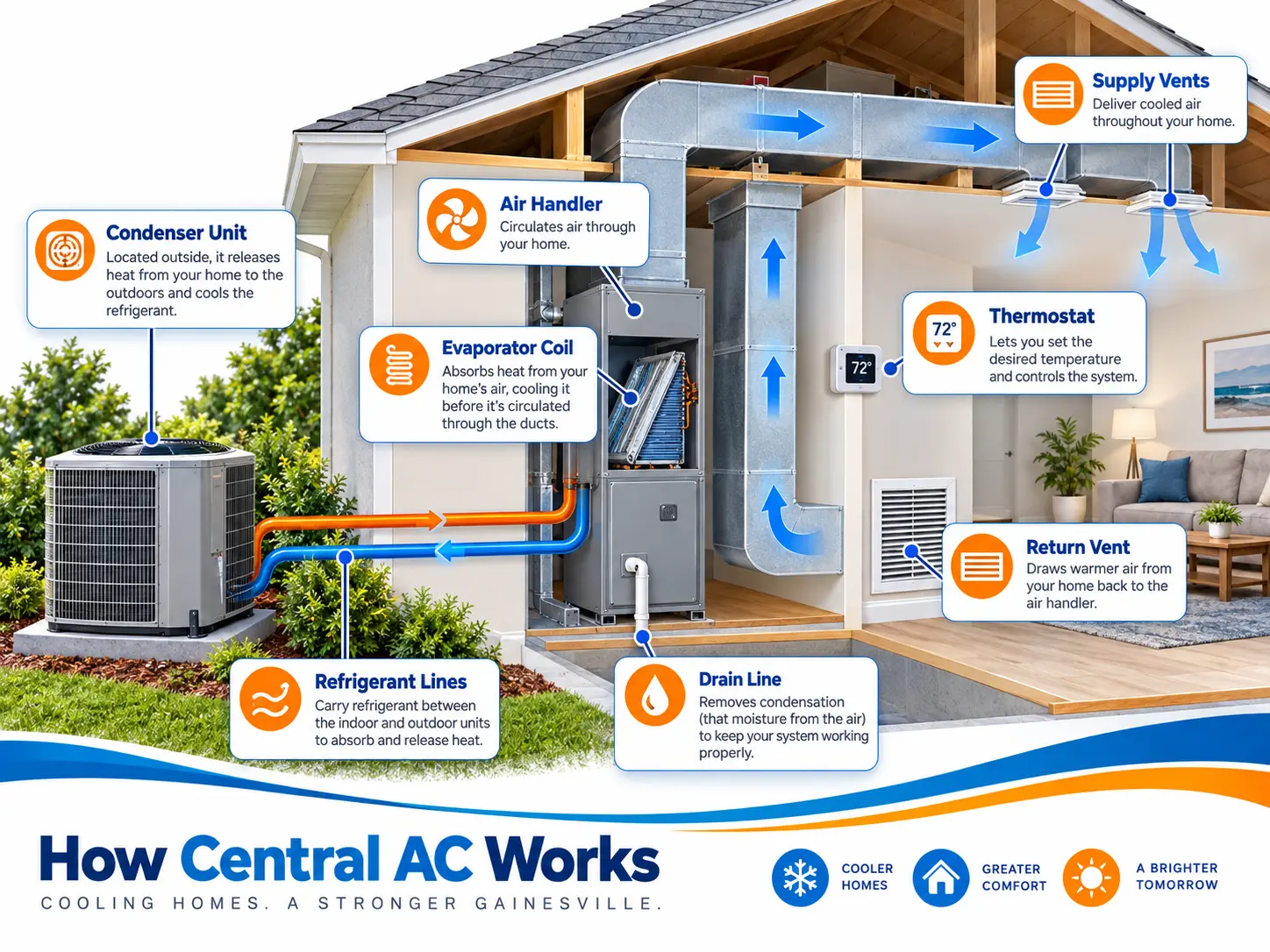
Repair conversations go better when the parts have names. This page walks the system from outside to inside and explains what each component does and how it typically fails.
24/7 availability for urgent cooling problems in Gainesville and nearby areas.
Outdoor side
Condenser coil
Releases heat to outdoor air. Fails by fouling with debris, corrosion or impact damage.
Compressor
Pumps refrigerant through the system. Fails electrically or mechanically, often after running under stress.
Condenser fan motor
Moves air across the outdoor coil. Fails from bearing wear, heat and moisture.
Run capacitor
Provides the phase shift motors need to start and run. One of the most common failures.
Contactor
The switch that sends line voltage to the compressor. Fails by pitting or welding shut.
Disconnect and wiring
Local shutoff with fuses or a pull-out. Corrosion and heat damage are common finds.
Indoor side
Evaporator coil
Absorbs heat and condenses moisture. Fails by fouling or by developing pinhole leaks.
Blower motor and wheel
Moves air through the ducts. Fails from bearing wear, capacitor loss or dust loading.
Metering device
A TXV or fixed orifice that controls refrigerant flow into the coil. Can stick or restrict.
Drain pan and line
Collects and removes condensate. Clogs and rust-through cause most water calls.
Float switches
Shut cooling down when water rises. A safety device, never something to bypass.
Control board
Manages timing, blower speeds and safeties. Vulnerable to power surges and moisture.
Connecting the two halves
- Line set: two copper lines, one insulated suction line and one liquid line.
- Filter drier: protects the system by capturing moisture and debris.
- Low-voltage wiring: carries thermostat calls to the equipment.
- Ductwork: supply trunk and branches, plus the return path back to the air handler.
- Filter rack: where filtration happens and where bypass leaks often hide.
- Thermostat: the control that starts and stops the whole sequence.
Which parts fail most often
| Component | Typical failure | Symptom you notice |
|---|---|---|
| Run capacitor | Loses capacitance or bulges | Humming outdoor unit, warm air |
| Contactor | Pitted or welded contacts | Intermittent cooling or unit that never stops |
| Condensate drain | Clog from biofilm and dust | Water indoors or system shutting off |
| Blower motor | Bearing or winding failure | No airflow from vents |
| Evaporator coil | Fouling or pinhole leaks | Weak cooling, ice, repeated low charge |
| Compressor | Electrical or mechanical failure | No cooling, tripping breaker, loud hum |
Frequently Asked Questions
- Which AC part fails most often?
- Small electrical components — run capacitors and contactors — along with condensate drain clogs. They are also among the least expensive to address when caught early.
- What is the difference between an air handler and a furnace?
- An air handler contains a blower and evaporator coil and is paired with a heat pump or AC. A furnace produces heat by combustion or electric strips and includes the blower for a cooling coil mounted with it.
- What does a TXV do?
- A thermostatic expansion valve modulates refrigerant flow into the evaporator coil to match load. When it sticks, the coil either starves and freezes or floods.
- Why does my system have two copper lines?
- One carries cool low-pressure refrigerant vapor back to the compressor, the other carries warm high-pressure liquid to the indoor coil. The insulated one is the suction line.
Related pages
Prefer to talk it through? Call 352-707-8045 or send a service request.
AC Trouble in Gainesville?
Describe the symptoms and get help scheduling air conditioner repair. Service requests are available 24/7.