Air quality and humidity
Indoor Air Quality in Gainesville, FL
In a humid climate, indoor air quality is mostly a moisture and filtration story. Control humidity, filter effectively without strangling airflow, and keep the wet parts of the system clean.
Equipment add-ons can help, but they cannot substitute for those three fundamentals.
24/7 availability for urgent cooling problems in Gainesville and nearby areas.
Start with the fundamentals
Humidity control
Filtration that fits
Clean coil and pan
Drain hygiene
Duct integrity
Ventilation and source control
Options that can help
| Option | What it addresses | What to know |
|---|---|---|
| Media filter cabinet | Particles, dust, some allergens | Deeper media captures more with less airflow penalty than a thick high-MERV panel in a small rack |
| Whole-home dehumidifier | Persistent high humidity | Useful when right-sized equipment still cannot hold humidity, especially in shoulder seasons |
| UV light at the coil | Growth on the coil surface | Targets the wet surface; not a replacement for cleaning or filtration |
| Ventilating dehumidifier | Fresh air with moisture control | Adds controlled outdoor air without dumping humidity into the house |
| Duct sealing | Contaminant entry, humidity load | Often the highest-value improvement in homes with attic ducts |
| Portable air cleaner | One problem room | Reasonable supplement; sizing to the room matters |
Filter selection without hurting the system
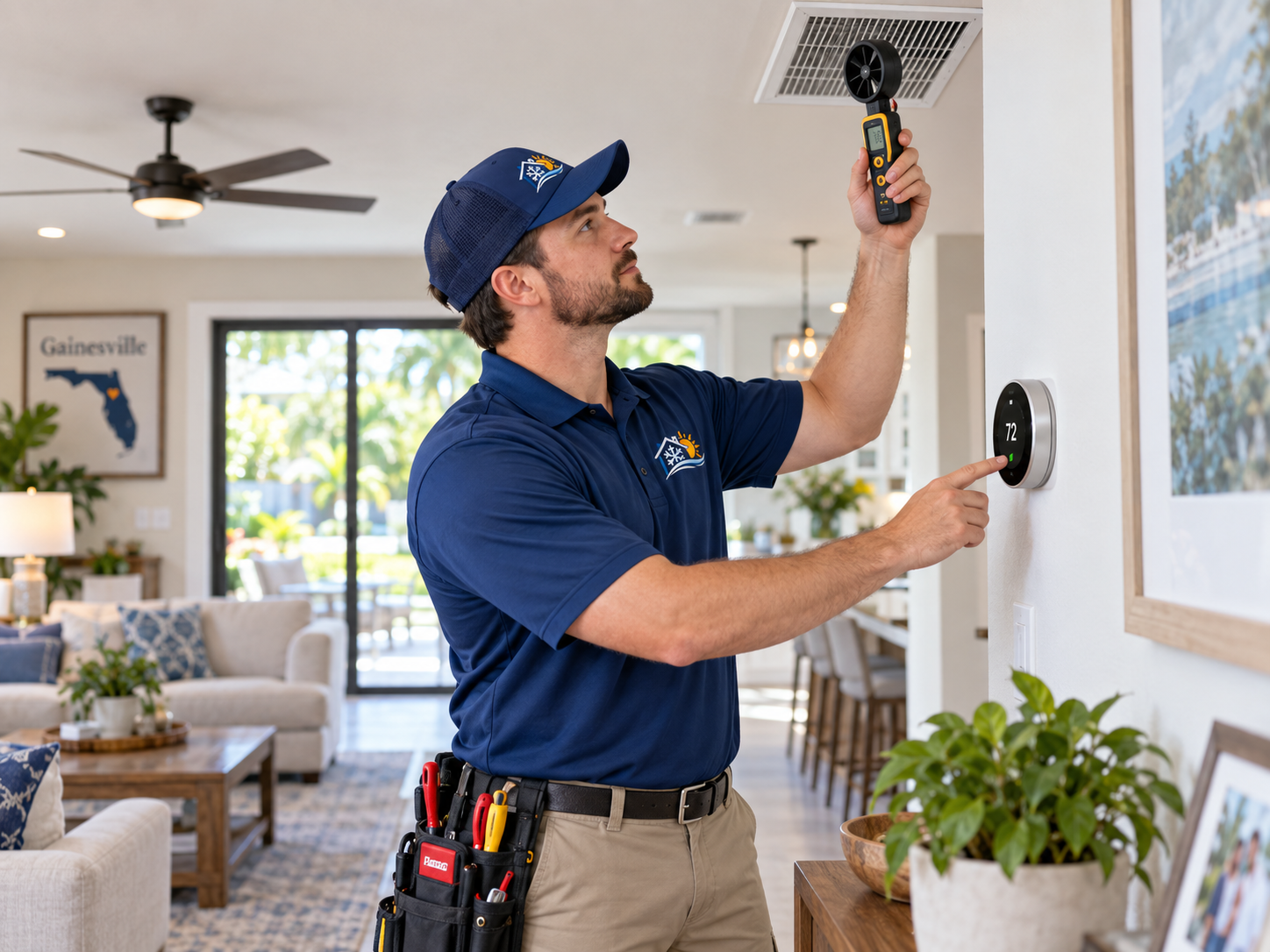
A very restrictive filter in an undersized return raises static pressure, reduces airflow and can drive coil freezing. More filtration is not automatically better if the duct system cannot support it.
The better path is a larger filter area — a deeper media cabinet or an additional return — so higher efficiency comes without an airflow penalty. Static pressure should be measured before and after any filter change.
If cooling weakened right after switching to a thicker or higher-MERV filter, that is a strong clue the filter is restricting airflow.
Humidity in Alachua County homes
Spring and fall are the hardest seasons for humidity. Outdoor moisture is high while cooling loads are low, so the air conditioner runs too little to dehumidify — and the house feels clammy at 76 degrees.
That is where variable-speed equipment, better thermostat setup or dedicated dehumidification earn their place, rather than simply lowering the setpoint and overcooling the house.
Frequently Asked Questions
- Why is my home humid even with the AC running?
- Common causes are oversized equipment that short cycles, excessive airflow across the coil, the fan set to ON re-evaporating moisture, duct leaks pulling in humid air, and mild weather with low cooling demand.
- What indoor humidity should I target?
- Many homeowners find the mid-40s to low-50s percent range comfortable. Very low targets are hard to reach here without dedicated dehumidification and are not usually necessary.
- Do UV lights fix musty smells?
- They can reduce growth on the coil surface they illuminate, but a dirty coil, wet pan or clogged drain has to be cleaned. UV is a supplement, not a substitute.
- Is the highest MERV filter the best choice?
- Only if the duct system can handle it. Measured static pressure decides. Otherwise, increase filter area instead of restriction.
Related pages
Prefer to talk it through? Call 352-707-8045 or send a service request.
AC Trouble in Gainesville?
Describe the symptoms and get help scheduling air conditioner repair. Service requests are available 24/7.